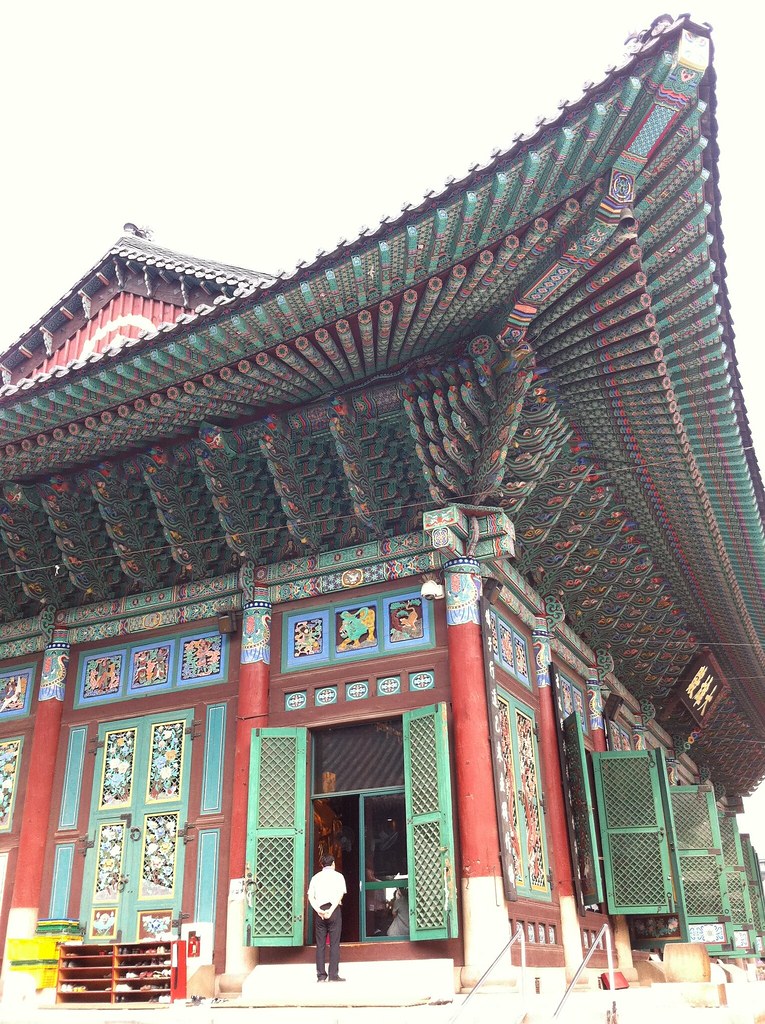
Jogyesa Temple
7.7Locals Score / 10free
The head temple of Korea's Jogye Zen order, right downtown near Insadong. Free, open roughly 4am-9pm, and spectacular in May when thousands of lotus lanterns fill the courtyard for the Yeondeunghoe festival. Small but deeply active, a genuine spiritual heart in the middle of the city.
Key facts
| Hours | Open daily approx. 04:00-21:00 |
|---|---|
| Price | free |
| Phone | — |
| Website | — |
| Nearest transit | Jonggak Station (Line 1), Exit 2 or Anguk Station (Line 3), Exit 6 |
| Time needed | 30-45 minutes |
| Best time to go | May for the Lotus Lantern Festival |
| Last verified | July 15, 2026 |
Locals Score
7.7/10- Value8.0
- Iconic7.0
- Freshness6.0
- Excellence7.5
- Crowd level6.5
- Authenticity8.0
- Accessibility9.0
Frequently asked questions
- Is Jogyesa Temple free to enter?
- Yes, entry is free year-round. It's an active temple in central Seoul, open to all. There's no ticket for the grounds or the main halls. Only optional programs or offerings involve money. Just step in and explore quietly.
- What are the hours?
- Jogyesa is generally open daily from around 4am to 9pm. Because it's a working temple, early mornings catch monks and worshippers at chanting, which is a special, quiet time to visit before the downtown crowds and nearby Insadong shops get going.
- Can visitors join any programs here?
- Jogyesa offers templestay and temple-life experiences and cultural programs, some in English, plus a nearby information center for foreign visitors. If you want more than a look-around, ask at the center about meditation sessions or making a lotus lantern, especially around festival season.
- Is it worth visiting outside festival season?
- Yes, though it's most magical in May. Any time of year it's a calm, free, authentic pause in the middle of a busy downtown day, and its central location makes it nearly free of effort to include. Just don't expect the lantern spectacle outside spring.
- How do I get to Jogyesa?
- It's a short walk from Jonggak Station on Line 1 (Exit 2) or Anguk Station on Line 3 (Exit 6). It sits about ten minutes on foot from Gyeongbokgung and right by Insadong, so it slots easily into any downtown historic day.
- What's the Lotus Lantern Festival at Jogyesa?
- Yeondeunghoe, a UNESCO-listed tradition, fills Jogyesa with a canopy of thousands of colorful paper lanterns each May, culminating in a huge night parade. It's the single best time to visit. The 2026 festival runs roughly May 8-25 with the grand parade mid-month, and it's all free.
- How is Jogyesa different from Bongeunsa?
- Jogyesa is smaller, more central and is the administrative head temple of the Jogye Order, so it's busy with real religious activity. Bongeunsa in Gangnam is larger, more scenic and has the giant Buddha. Both are free and worth it; Jogyesa is the easy downtown option.
- What should I see inside the temple?
- The main hall, Daeungjeon, is one of Korea's largest wooden Buddhist halls and holds three large gilded Buddha statues. There's an ancient locust tree and a white pine in the courtyard, and seasonal flower or lantern displays. It's compact, so 30 minutes covers it well.
Nearby in Ask Seoul
- InsadongNeighborhood0.33 km · 4 min walk
- Bukchon Son ManduRestaurant0.33 km · 4 min walk
- National Museum of Modern and Contemporary Art (MMCA) SeoulMuseum0.47 km · 6 min walk
- Dongbinggo HanjeongsikRestaurant0.61 km · 8 min walk
- Peel the LoveCafé0.62 km · 8 min walk
Where to stay near Jogyesa Temple
Compare hotels & stays on Booking.com · doesn’t affect the Locals Score