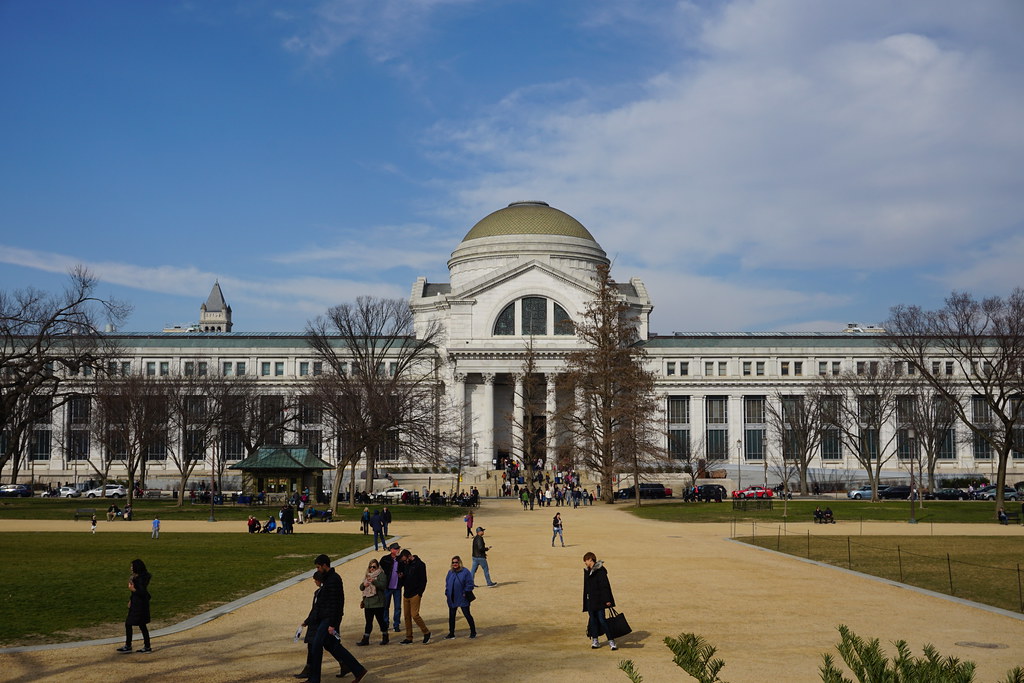
Smithsonian National Museum of Natural History
The Smithsonian's National Museum of Natural History on the National Mall is the world's largest natural history museum, housing more than 148 million specimens — all free to visit. Iconic draws include the 45.52-carat Hope Diamond, the Deep Time fossil hall, and Henry the African Bush Elephant in the Rotunda.
Key facts
| Hours | Daily 10:00–17:30 |
|---|---|
| Price | free |
| Phone | — |
| Website | — |
| Nearest transit | Federal Triangle Metro (Blue/Orange/Silver lines) — 2-min walk; Archives-Navy Memorial (Green/Yellow lines); Metro Center (Red line) |
| Time needed | 2–3 hours for highlights; a full day to explore all halls |
| Best time to go | Weekday mornings at opening (10 a.m.) or after 3 p.m. to avoid school groups and peak crowds; extended evening hours (to 7:30 p.m.) offered on select spring/summer days |
| Last verified | July 12, 2026 |
Locals Score
- Value9.0
- Freshness5.9
- Crowd level5.0
- Authenticity8.5
- Accessibility8.5
Frequently asked questions
- How do I get to the museum by Metro?
- The closest station is Federal Triangle on the Blue, Orange, and Silver lines, roughly a 2-minute walk away. The Archives-Navy Memorial station (Green/Yellow lines) and Metro Center (Red line) are also nearby options.
- How much time should I plan for a visit?
- Plan 2–3 hours to hit the major highlights such as the Hope Diamond and the fossil hall. A thorough visit covering all three floors and multiple halls can easily fill a full day. The museum is large — comparable in size to 18 football fields.
- What are the museum's hours?
- The museum is open daily from 10 a.m. to 5:30 p.m., closed only on December 25. Extended hours until 7:30 p.m. are offered on select spring and summer days — check naturalhistory.si.edu for the current extended-hours calendar.
- What are the must-see exhibits?
- Top permanent exhibits include the Hope Diamond, the David H. Koch Hall of Fossils–Deep Time (dinosaurs and prehistoric life), the Sant Ocean Hall (featuring a life-size North Atlantic right whale replica), the Hall of Human Origins, and the Kenneth E. Behring Family Hall of Mammals. Henry, the 11-ton African Bush Elephant, greets visitors in the main Rotunda.
- Where is the Hope Diamond, and can I see it for free?
- The 45.52-carat Hope Diamond is on permanent display in the Janet Annenberg Hooker Hall of Geology, Gems and Minerals (Harry Winston Gallery) and is included with free general admission. In April 2025, the Winston Red Diamond and Winston Fancy Color Diamond Collection were donated and are now displayed alongside it.
- Is admission to the National Museum of Natural History free?
- Yes — like all Smithsonian Institution museums, general admission is completely free and no tickets or passes are required. Some special programs (such as the Butterfly Pavilion) may carry a separate fee; check the museum website for current details.
- Is there parking at the museum?
- The Smithsonian does not operate public parking on the National Mall. Limited on-street metered parking exists nearby, and designated accessible spaces are available around the Mall. The museum strongly encourages visitors to use Metro or Metrobus.
- Is the museum accessible for visitors with disabilities?
- Yes — all exhibitions are wheelchair accessible, every public floor is reachable by elevator, and all food-service areas are step-free. A limited number of manual wheelchairs are available free of charge on a first-come, first-served basis. The nearest accessible Metro entrance is Federal Triangle (west side of 12th St. NW).
Nearby in Ask Washington DC
- National Museum of Natural HistoryMuseum0.01 km · 0 min walk
- How to Do DC's Free Museums RightAttraction0.2 km · 3 min walk
- National MallPark0.29 km · 4 min walk
- National Museum of American HistoryMuseum0.36 km · 4 min walk
- Hirshhorn Museum and Sculpture GardenMuseum0.43 km · 5 min walk
Where to stay near Smithsonian National Museum of Natural History
Compare hotels & stays on Booking.com · doesn’t affect the Locals Score